
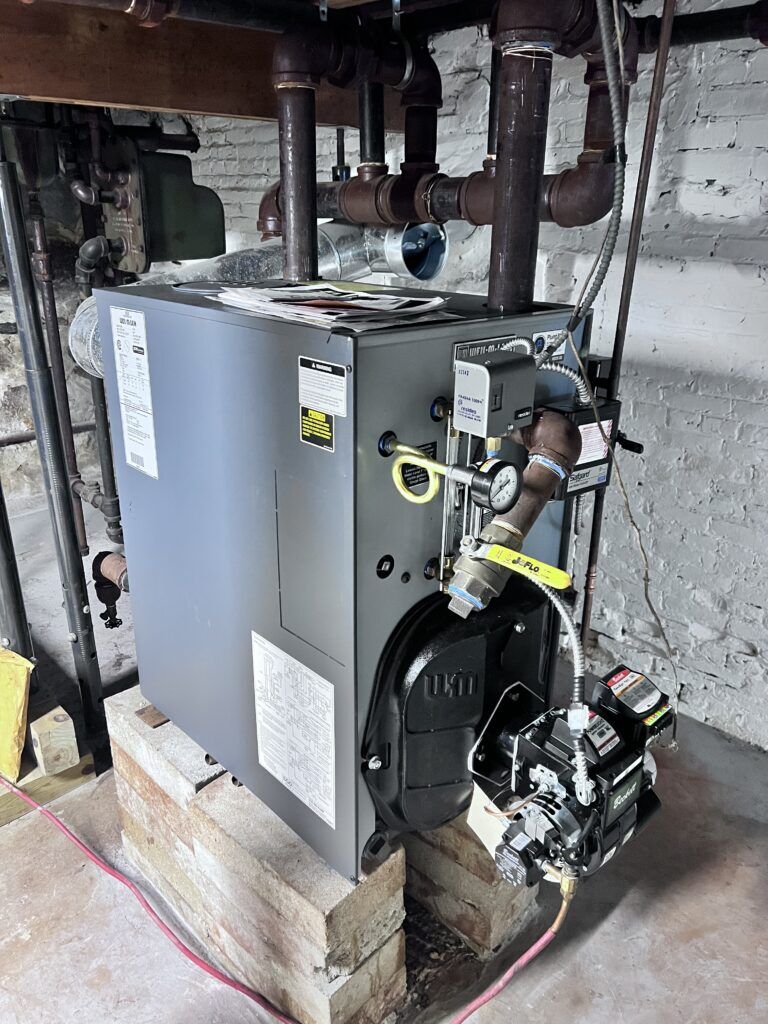
Updated November 3, 2026. By Ronald Nevers, owner of Plumbtech, LLC, Watertown, CT
The first cold snap in Litchfield County is a bad time to find out your boiler won’t fire. A boiler maintenance checklist helps you avoid that by splitting the work into two parts: quick owner checks you can do safely and technician tasks that make up an annual boiler service.
Direct answer: A boiler maintenance checklist for a Connecticut home has two parts. Homeowners check pressure, leaks, vents, and carbon monoxide (CO) detectors. A licensed technician cleans, tests safety controls, and checks combustion. Connecticut’s boiler inspection law doesn’t cover boilers in private homes, so no state inspector will do it for you [1].
Both lists are below, with a printable version at the end.
TL;DR
- Connecticut’s boiler law skips boilers in private homes and apartment houses of up to five families, so no state inspector checks yours [1].
- Owner checks: pressure gauge, leaks, clear space, vents, thermostat, every room warming, condensate line, CO detectors, and an early test run [5].
- Annual boiler service covers the burner, heat exchanger, combustion analysis, low-water cutoff, controls, and venting [6][7].
- Service a boiler every year, preferably before you depend on it heavily in the heating season [4].
- Book a boiler tune-up before winter, preseason, before harsh winter weather hits [4].
- Leave panels and gas parts to a technician, and never ignore a CO alarm [5][7].
One-liner: In Connecticut, nobody inspects your home boiler but you and your technician, so run the owner checks and book annual service before the heating season.
Key Numbers
| Figure | Value | Source |
|---|---|---|
| Home boiler exemption from state boiler law | Private homes and apartment houses for up to 5 families | Connecticut General Statutes (CGS) 29-231, 2025 [1] |
| CO detector affidavit at closing | One- and two-family homes and condo units | CGS 29-453, 2024 [8] |
| Plumbtech, LLC recommended boiler service | Every year, preferably before the heating season | Plumbtech, 2026 [4] |
| Low-water cutoff accidents in steam heating boilers | More than two-thirds | National Board, 1996 [11] |
| Energy content, propane vs. natural gas | About 2,500 vs. 1,000 British thermal units (BTU) per cubic foot | Weil-McLain, 2026 [12] |
| Plumbtech, LLC workmanship warranty | Three years, on top of manufacturer warranties | Plumbtech, 2026 [13] |
No One Inspects Your Home Boiler in Connecticut
In short: Connecticut’s boiler inspection law skips home boilers, so the yearly check is up to you.
Connecticut’s boiler law doesn’t apply to steam or hot-water heating boilers in private homes or apartment houses with up to five families [1]. In plain terms, no state inspector will ever look at the boiler in your basement.
The law does cover boilers outside that exemption, such as those in schools, offices, and larger apartment buildings. Those boilers can’t run without a state operating certificate posted in the boiler room, issued after a state or insurance company inspector checks the equipment [2].
Picture two boilers. One sits in a school, with a certificate under glass on the wall and an inspector on the calendar. The other sits in your basement, with nothing on the wall and no one scheduled to look at it.
That gap is why many boiler checklists online miss the mark for homeowners. Plenty of them are boiler-room programs, like the National Board’s suggested log, with daily blowdowns and a yearly visit from a commissioned inspector [3]. They’re written for commercial operators, not a family with a hot water boiler.
For a home boiler, your own checks and a technician’s visit are the only checks it gets. Follow the owner’s manual for your model [5], and book professional boiler service [4] before the heating season starts.
Owner Checks You Can Do Safely
In short, these nine checks are safe for homeowners and avoid the parts that belong to a technician.
Run them in the preseason, before you need steady heat.
- Check the pressure gauge. Compare the reading with the range in your owner’s manual, since the right number varies by system. Pressure that keeps dropping, climbing, or swinging needs a technician [5].
- Look for leaks. Check around the boiler, piping, valves, pumps, radiators, and baseboards for water, staining, or corrosion, including the pipe under the pressure relief valve. Dripping water can point to a pressure problem [5][6].
- Clear the space. Move boxes and stored items away, and keep paint, solvents, cleaners, and gasoline out of the boiler area. Stored items can also block the combustion air a boiler needs [5].
- Look at the vents. Check the vent and air intake pipes, as well as their outdoor openings, for leaves, debris, loose joints, or damage. Look only, and call if something’s wrong [5].
- Test the thermostat. Set it above room temperature and confirm the boiler starts. Swap the batteries if it uses them [5][7].
- Walk the house. Once heat is running, note any cold radiators, cool zones, or new banging or gurgling. Check your manual or ask a technician before bleeding radiators [5][7].
- Check the condensate line. On a high-efficiency boiler, look at the condensate tubing for leaks or blockages, but don’t disconnect it [5].
- Test your CO detectors. Press the test button and replace weak batteries or old units. In Connecticut, sellers of a one- or two-family home or a condo unit with a fuel-burning appliance must provide the buyer with an affidavit confirming that CO detection is installed [8].
- Run the boiler early. Turn the heat on before the first cold night, so there’s time to call if it won’t start or can’t keep up [5].
Stop outside the boiler. Bryant’s homeowner guide tells owners never to open internal panels or adjust gas parts [7]. If a check looks wrong, call a technician instead of fixing it yourself.
Annual Boiler Service: What the Technician Does
In short: An annual boiler service covers the parts you can’t safely reach: combustion, safety controls, water condition, and venting.
An annual boiler service is when the actual cleaning and testing take place. Bryant’s guide states that internal parts, combustion, and safety controls require a qualified technician [7]. From the outside, you can spot a leak. With the panels off, a technician can see buildup on the heat exchanger or a worn flame sensor [6].
Expect the visit to cover three groups of work [6][7]:
Combustion and safety
- Clean and inspect the burner and heat exchanger
- Test the igniter and flame sensor
- Check gas pressure
- Run a combustion analysis to confirm safe burning and spot carbon monoxide concerns
Water side
- Test the low-water cutoff
- Check the system water, including pH, on high-efficiency boilers
- Flush the system piping if the water is dirty
Venting and controls
- Inspect the vent and flue for blockage, leaks, or corrosion
- Clean and flush the condensate system on condensing boilers
- Test the safety and operating controls
- Check wiring and pipe connections
Ask for a written report that lists what was checked, measured, and fixed. It helps the next technician, and it’s useful if a warranty question comes up, since warranty terms vary by manufacturer and model [7].
Plumbtech, LLC maintains residential boilers in Watertown and across Litchfield County [4].
Owner Tasks vs. Technician Tasks
In short: You watch and report. The technician opens, cleans, measures, and adjusts.
Here’s how the two lists split, area by area [5][6][7].
| Area | What You Check | What the Technician Does |
|---|---|---|
| Pressure | Read the gauge and compare it with your manual | Finds the cause of drops or climbs and corrects it |
| Leaks and piping | Look for water, staining, or corrosion | Checks pipe connections and repairs leaks |
| Venting | Look for debris or damage at pipes and outdoor openings | Inspects the vent and flue for blockage, leaks, or corrosion |
| Combustion and burner | Nothing; leave panels closed | Cleans the burner and heat exchanger, checks gas pressure, and runs a combustion analysis |
| Safety controls | Test CO detectors | Tests the low-water cutoff and the safety and operating controls |
| Condensate (high-efficiency) | Look at the tubing for leaks or blockages | Cleans and flushes the condensate system |
If your check turns up a problem in any row, that row becomes a service call.
How Often Should You Service a Boiler?
In short: Every year, preferably before the heating season starts.
You should service a boiler every year, preferably before you depend on it heavily during Connecticut’s heating season [4]. Plumbtech, LLC recommends booking the tune-up preseason, so you’re not let down when it’s coldest. An annual maintenance visit extends the life of your heating system and helps detect and avoid hazards [4].
Since Connecticut’s boiler law doesn’t cover home boilers [1], no state inspection schedule applies. Your yearly service visit is scheduled.
Keep the report from every visit. The reports build a service history that shows your boiler’s condition over time [9].
Boiler Tune-Up Before Winter: When to Book
In short: Book preseason, before harsh winter weather hits and before you rely on heat every day.
Book your boiler tune-up before winter, preseason, before you depend on the system heavily [4]. Plumbtech, LLC recommends it so you’re not let down when it’s coldest [4].
Before harsh winter weather hits, a technician checks all components and makes sure the system is running smoothly and, most importantly, safely [4]. Any problem that turns up before the house depends on the boiler every day.
A preseason visit is a routine appointment. The same issue found on a freezing night is a no-heat call.
Checklist Notes by Boiler Type
In short: The core checklist works for every boiler, but fuel and design add a few items.
Use the main lists above, then add the items for your boiler type.
| Boiler type | Extra owner check | Extra technician focus |
|---|---|---|
| Natural gas | Test CO detectors and confirm their placement [5] | Combustion analysis and a gas pressure check [7] |
| Propane | Same owner checks as natural gas | Confirms the boiler is set up for propane, with the right parts and combustion settings [12] |
| High-efficiency condensing | Look over condensate tubing and outdoor vent openings [5] | Cleans the condensate system, checks water pH, inspects intake and vent pipes [6] |
| Steam | Watch the water level in the sight glass | Checks the low-water cutoff and shows you the blowdown routine in your manual [11] |
Steam boilers deserve extra care. A National Board article on its 1995 incident data found that more than two-thirds of low-water cutoff accidents occurred in steam-heating boilers, and the engineers it interviewed traced most cutoff failures to poor maintenance [11]. Follow the blowdown schedule in your manual, and ask your technician to walk you through it once.
Propane and natural gas require different gas flow and pressure settings, as determined by a combustion analyzer [12]. If your boiler has switched fuels, make sure the first service confirms the setup is correct. Plumbtech, LLC handles oil-to-propane conversions [4].
Boiler Maintenance Cost in Connecticut
In short: The price depends on your boiler and what the visit turns up, so get a quote for your own system.
Your boiler maintenance cost depends on three things: the type of boiler and fuel, its age and condition, and any parts or cleaning the technician finds it needs [7]. That’s why a quote for your own system tells you more than a general number.
Routine maintenance generally costs less than major repairs or a replacement [7]. A preseason tune-up is a planned visit. A worn part that fails during a cold snap becomes a repair bill.
Plumbtech, LLC offers free estimates [10]. Its site also lists $0 down, 0% annual percentage rate (APR) financing with credit approval, and a three-year workmanship warranty in addition to manufacturer warranties [13]. Request a quote through the contact page to price your boiler [10].
Common Mistakes and Warning Signs
In short: Skip the commercial checklists and the screwdriver, and call when the boiler starts acting differently.
The most common mistake is following a boiler-room checklist at home. Daily operator logs and boiler blowdowns are written for commercial boiler rooms [3]. A home boiler follows its own manual.
The second is reaching inside. Bryant tells homeowners never to open internal boiler panels or adjust gas components, since those jobs need tools and training [7].
The third is storage creep. Basements tend to fill up over the summer, and paint, solvents, cleaners, and gasoline don’t belong near a boiler [5].
Call a technician if you notice [5][7]:
- Pressure that keeps rising or falling
- Water around the boiler, piping, pumps, radiators, or baseboards
- New banging, gurgling, or other unusual noises
- Rooms or zones that no longer warm up
- Frequent shutdowns, lockouts, or error codes
- A yellow pilot flame instead of blue
- Heating bills that jump without a clear reason
If a CO alarm goes off, don’t troubleshoot. Leave the home and follow the detector maker’s emergency guidance [5].
A change in how your boiler sounds or behaves is worth a call before winter. Plumbtech, LLC handles boiler repairs and maintenance [4].
Your Printable Boiler Maintenance Checklist
In short: Print this section, keep it by the boiler, and fill in the service line each year.
Print this section and keep it near the boiler.
Owner checks (preseason)
- Pressure gauge reads within your manual’s range
- No leaks, staining, or corrosion
- Area around the boiler clear of stored items and chemicals
- Vent and intake openings free of debris
- Thermostat starts the boiler; batteries changed
- Every room and zone warms up
- Condensate tubing clear (high-efficiency boilers)
- CO detectors tested
- Boiler test-run before the first cold night
Annual boiler service (technician)
- Burner and heat exchanger cleaned and inspected
- Igniter, flame sensor, and gas pressure checked
- Combustion analysis done
- Low-water cutoff and safety controls tested
- Vent, flue, and condensate system inspected and cleaned
- Written report received
Service record: date serviced, technician, and notes [9].
Book the technician half through Plumbtech’s boiler service [4], or request a visit through the contact page [10].
Boiler Maintenance FAQ
In short, Connecticut doesn’t inspect home boilers, so owners and technicians share the job.
Does Connecticut require inspections for home boilers?
No. Connecticut’s boiler law doesn’t apply to steam or hot-water heating boilers in private homes or apartment houses with up to five families [1]. Boilers the law does cover need a state operating certificate to be posted in the boiler room [2]. For a home boiler, your checks and a technician’s service are the only inspections it gets.
Can I service my own boiler?
You can handle the owner checks, but not the service itself. Pressure, leaks, vents, and CO detectors are fine for homeowners. Bryant directs owners to qualified service personnel for maintenance and cleaning and warns against opening internal panels or adjusting gas parts [7].
What should I check on a boiler when buying a home in Connecticut?
Have the boiler checked and serviced before you buy or when you move in, especially if it burns gas [4]. Also confirm CO detection. Connecticut requires the seller of a one- or two-family home or condo unit to provide the buyer with an affidavit at closing regarding smoke and CO detectors [8].
Should I drain or flush my boiler every year?
Not as an owner task. During service, a technician checks the system water and flushes the piping for power only if the water is dirty [6]. Scheduled draining is part of commercial boiler-room programs [3].
Does skipping maintenance affect my boiler warranty?
It can. Warranty terms vary by manufacturer and model, so read the warranty certificate and owner’s manual for your boiler [7]. Keep the written report from every visit in case you need to file a claim.
What pressure should my boiler be at?
There’s no single number for every home. Weil-McLain recommends using the range in their boiler’s manual rather than a universal setting [5]. If the pressure keeps dropping, climbing, or swinging, call a technician instead of adjusting anything yourself.
What happens if I skip boiler maintenance?
You give up the yearly check. An annual maintenance visit extends the life of your heating system and helps detect and avoid hazards, so skipping it means giving up both [4].
Definition Bank
| Term | Plain-English Definition |
|---|---|
| Boiler | A heater that warms water or makes steam and sends it through radiators, baseboards, or radiant loops. |
| Hot water (hydronic) boiler | A boiler that circulates heated water through the home. |
| Steam boiler | A boiler that turns water into steam, which rises to radiators. |
| Condensing boiler | A high-efficiency boiler that cools flue gases enough to form condensate. |
| Condensate | Acidic water that a condensing boiler produces and drains away. |
| Low-water cutoff | A safety switch that shuts off the burner if the water level drops too low. |
| Combustion analysis | A test of flue gases to confirm safe, efficient burning. |
| Sight glass | A glass tube on a steam boiler that shows the water level. |
| Operating certificate | A state permit to run a boiler is covered by Connecticut’s boiler law. |
Entity Cards
Connecticut General Statutes Sec. 29-231
| Property | Value |
|---|---|
| What it is | Exceptions to Chapter 540, Boilers and Water Heaters |
| Home boiler rule | Item (4) excludes steam and hot water heating boilers in private homes and apartment houses of up to five families |
| Edition checked | 2025 [1] |
Connecticut General Statutes Sec. 29-453
| Property | Value |
|---|---|
| What it is | Smoke and carbon monoxide detector affidavit at closing |
| Who it covers | One- and two-family homes and units in common interest communities |
| CO exemption | Homes with no fuel-burning appliance, fireplace, or attached garage [8] |
Plumbtech, LLC
| Property | Value |
|---|---|
| Location | Watertown, CT 06795 |
| Boiler services | Installation, replacement, repair, maintenance, oil to propane conversion [4] |
| Warranty | 3-year workmanship warranty on top of manufacturer warranties [13] |
| Owner | Ronald Nevers |
| Phone | (203) 565-6487 |
Sources
- Connecticut General Statutes Sec. 29-231, Exceptions (Chapter 540, Boilers and Water Heaters), 2025 edition. https://law.justia.com/codes/connecticut/title-29/chapter-540/section-29-231-formerly-sec-19-426/
- Connecticut General Statutes Sec. 29-238, Operating certificate, fee, period of validity, inspection, 2024 edition. https://law.justia.com/codes/connecticut/title-29/chapter-540/section-29-238-formerly-sec-19-435/
- National Board of Boiler and Pressure Vessel Inspectors, Suggested Maintenance Log Program (Classic Series). https://www.nationalboard.org/index.aspx?pageID=164&ID=240
- Plumbtech, LLC, Boilers. https://www.plumbtechllc.com/boilers/
- Weil-McLain, Boiler Winter Maintenance Checklist (November 2025, updated July 2026). https://www.weil-mclain.com/news/boiler-winter-ready-checklist/
- Weil-McLain, A Guide to Maintaining High-Efficiency Boilers (2020, updated March 2026). https://www.weil-mclain.com/news/a-guide-to-maintaining-high-efficiency-boilers/
- Bryant, Boiler Maintenance: A Homeowner’s Guide (accessed October 2026). https://www.bryant.com/en/us/products/boilers/boiler-maintenance/
- Connecticut General Statutes Sec. 29-453, Smoke and carbon monoxide detectors required in certain residential buildings, 2024 edition. https://law.justia.com/codes/connecticut/title-29/chapter-541a/section-29-453/
- Plumbtech, LLC, Why Annual Heating Tune-Ups Are Critical in the CT Climate (November 2025). https://www.plumbtechllc.com/why-annual-heating-tune-ups-are-critical-in-the-ct-climate/
- Plumbtech, LLC, Contact Us. https://www.plumbtechllc.com/contact-us/
- National Board of Boiler and Pressure Vessel Inspectors, Low-Water Cutoff: A Maintenance Must (Spring 1996, 1995 incident data). https://www.nationalboard.org/Index.aspx?pageID=164&ID=220
- Weil-McLain, Natural Gas to Propane Boiler Conversion (January 2026). https://www.weil-mclain.com/news/natural-gas-to-propane-boiler-conversion/
- Plumbtech, LLC, Homepage (financing and warranty). https://www.plumbtechllc.com/

